 |
|
|
|
|
|
|
|
|
|

|
|
|
|

|
|
|
|
|
|
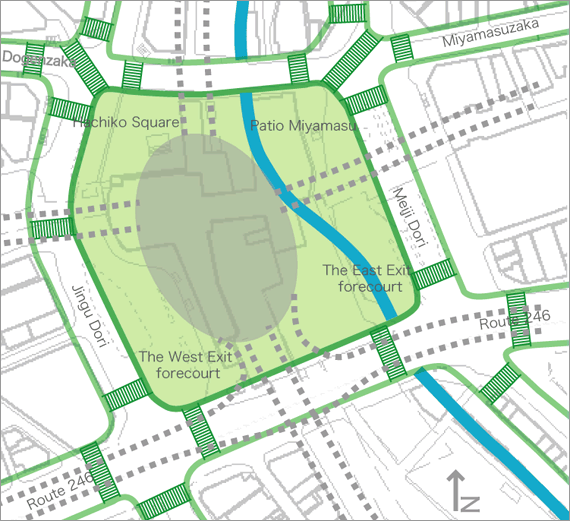
Hachiko Square serves as a gateway to the district for two reasons. The first is that Jingu Dori and Miyamasuzaka/Dogenzaka (formerly the Oyamakaido) serve mainly local rather than through traffic, which allows pedestrians and cars to coexist, for example at the "scramble" intersection allowing pedestrians to cross diagonally. The other is that Hachiko Square is not a public transport space, i.e. a bus terminal. If through traffic on Meiji Dori and Route 246 were to be separated off by an underpass and overpass, the Miyamasuzaka intersection, intersection in front of the Shibuya police station and Sakuragaoka intersection would also accommodate such a "scramble" arrangement. Moreover if the bus terminals occupying the East and West Exit forecourts were relocated underground and/or on decks with the separation of through traffic, these areas too would no longer be public transport spaces, instead functioning as gateways to the district similar to Hachiko Square. Then if these four precincts could be joined around a central shaft formed by the station, they would form the innermost ring connecting the streets of Shibuya, currently split crosswise by the Yamanote Line and Route 246, creating a single "Shibuya Common". |
|
|
|
|
|
|









